 Chrono

Home / About ChronoBridge
About ChronoBridge
Bringing biological time
into metabolic research
ChronoBridge investigates how biological clocks coordinate metabolism, how this coordination breaks down in disease, and whether restoring it can improve metabolic function.
A European program in chronometabolism
ChronoBridge — Bridging Chronobiology and Physiology through Expert Training — is a European Marie Skłodowska-Curie Doctoral Network coordinated by EPFL. It combines fundamental research, quantitative biology and translational approaches with a shared ambition: to make biological time an integral part of biomedical research.
The program works at the interface of chronobiology, physiology and metabolism, a field known as chronometabolism. Alongside its research objectives, it trains a new generation of scientists to investigate temporal organisation across biological scales and develop the foundations of chronomedicine.
Why biological time matters
Nutrient utilisation, energy production, hormone secretion and gene expression change throughout the day. Circadian clocks — biological oscillators with a period of approximately 24 hours — contribute to this temporal organisation.
In mammals, a central clock in the hypothalamic suprachiasmatic nucleus helps coordinate clocks in peripheral tissues. The liver, skeletal muscle, adipose tissue, intestine and pancreas also maintain their own rhythmic programs, which interact with feeding cycles, physical activity and hormonal signals.
ChronoBridge focuses on how these rhythms are coordinated within cells, between cells and across organs. Identifying a rhythmic gene or metabolite is only part of the challenge: understanding which signals regulate its timing, how it relates to other biological functions and what happens when coordination fails is equally important.
The scientific challenge
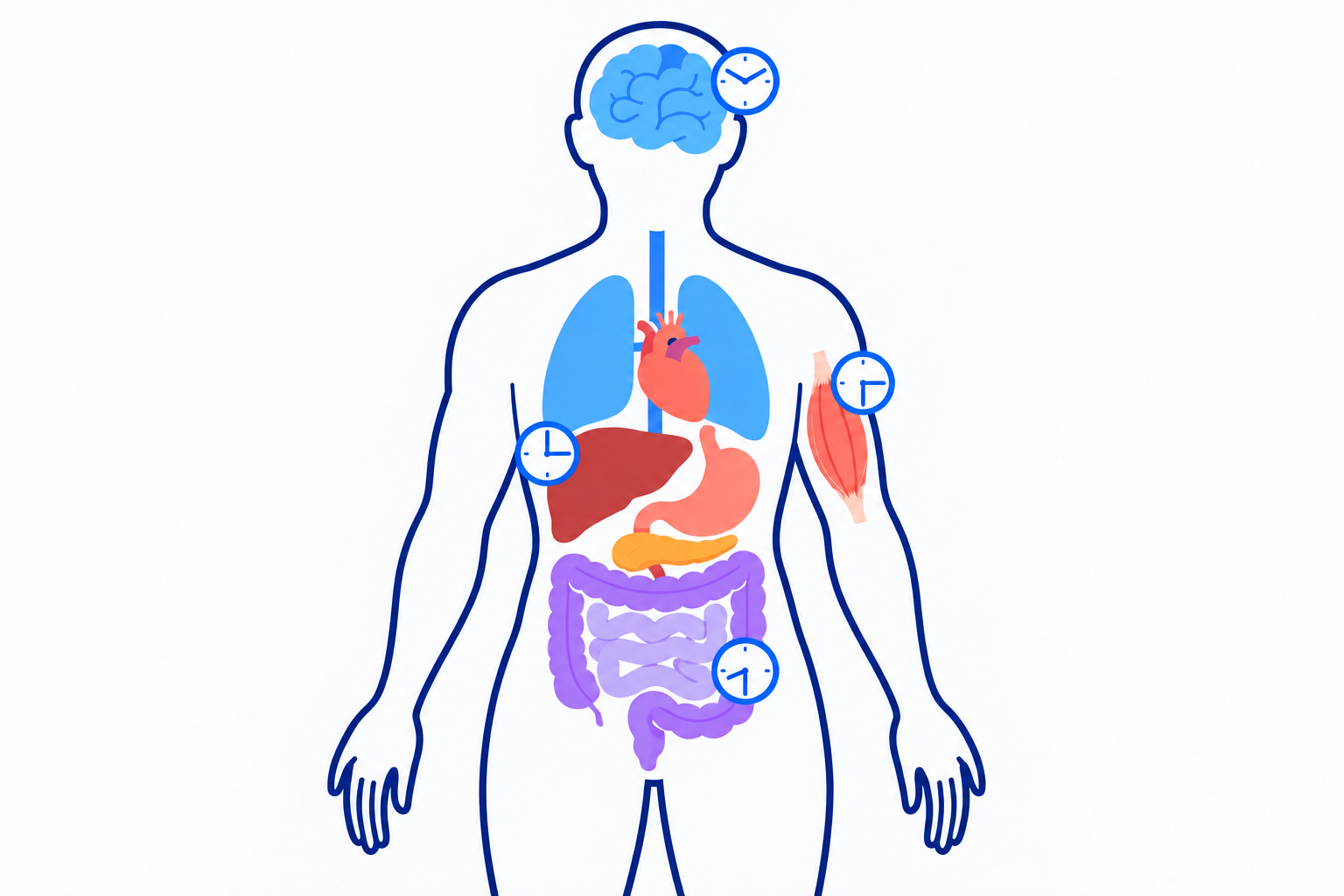
Understanding metabolic desynchronisation
Biological rhythms can become misaligned when environmental and behavioural cues no longer match the body's internal temporal organisation. Mistimed eating, shift work, light exposure at night and disrupted sleep–wake cycles provide important contexts for studying this problem.
ChronoBridge examines how disrupted rhythms relate to obesity, type 2 diabetes and liver metabolic dysfunction. Its research addresses four connected questions:
- Which signals synchronise cellular clocks and metabolic functions within and between organs?
- How do nutrition, hormones and exercise influence this temporal organisation?
- How can reduced clock activity be distinguished from a loss of synchrony between individual cells?
- Can resynchronisation improve impaired metabolic function, and through which mechanisms?
The distinction between weak oscillations and poor synchrony is crucial. A weak rhythm measured across a tissue may arise because each cell oscillates weakly, or because strongly oscillating cells are out of phase with one another. These situations require different interpretations and potentially different interventions.
Research program
Three connected scientific axes
ChronoBridge is organised around three research Work Packages (WPs): coordinated sets of activities addressing specific scientific objectives. Together, they connect the discovery of synchronising signals with mechanistic understanding and the evaluation of resynchronisation strategies.
WP1 · Synchronisation Signals
Discover how cells and organs coordinate their biological rhythms
Which molecular signals help our biological clocks stay in sync? WP1 investigates how cells communicate timing information and how this shapes metabolism, from neighbouring cells to communication between organs.
What you could work on
- Discover secreted molecules that can reset cellular clocks and investigate how they work.
- Explore liver-derived signals that influence feeding patterns and metabolic rhythms across the body.
- Develop single-cell assays and computational models to measure circadian timing and synchrony.
How you will approach the research
Projects combine experimental biology, molecular profiling and quantitative analysis. Depending on your position, you will investigate biological signals or develop tools that help researchers distinguish weakened cellular rhythms from a loss of coordination between cells.
WP2 · Signalling Pathways for Synchronisation
Explore how exercise, nutrition and hormones shape biological timing
How do cells translate changes in activity, food intake and hormonal signals into rhythmic metabolic functions? WP2 investigates the mechanisms that connect these cues to biological clocks, gene regulation and tissue function.
What you could work on
- Investigate how exercise timing influences energy sensing and mitochondrial metabolic rhythms in skeletal muscle.
- Understand how nutritional and hormonal signals regulate circadian gene expression and metabolism in the liver.
- Map how cellular clocks are coordinated across different cell types and regions of the liver and intestine.
How you will approach the research
Projects combine experimental interventions with molecular profiling, single-cell and spatial approaches, and computational analysis. You will help explain how changes in feeding or activity reshape biological timing and how this affects tissue function.
WP3 · Metabolic Desynchrony and Resynchronisation in Disease
Investigate disrupted rhythms and explore ways to restore metabolic function
How are altered biological rhythms linked to metabolic disease and tissue injury? WP3 investigates these connections and tests whether restoring rhythmic organisation can improve function in disease-relevant settings.
What you could work on
- Study circadian disruption in muscle, adipose tissue and insulin-producing pancreatic cells.
- Investigate timed nutritional interventions and molecular approaches to improving metabolic rhythms.
- Test whether circadian interventions can reduce injury and improve liver graft function during preservation outside the body.
How you will approach the research
Projects use human-derived cells, experimental disease models, clinical samples and ex vivo liver perfusion. You will assess both biological rhythms and functional outcomes to understand whether, how and under which conditions resynchronisation is beneficial.
European collaboration & doctoral training
Bringing complementary expertise together
Coordinated by EPFL, the network combines expertise in quantitative chronobiology, circadian signalling, transcriptional regulation, muscle physiology, liver metabolism, adipose tissue, nutritional interventions and human experimental models.
Industrial partners contribute complementary capabilities: BioTalentum in stem-cell-derived models, Bienta in screening and molecular development, and BGI in sequencing and data analysis. Clinical partners and the patient association AMFE help connect research questions and communication activities with clinical contexts and patient perspectives.
Training scientists to work across disciplines
Each doctoral candidate addresses a defined research question while accessing methods, infrastructure and expertise across the network. Research visits, experimental and computational courses, bioinformatics workshops and scientific exchanges develop the ability to design temporal experiments, analyse complex circadian datasets and work across academic, industrial and clinical environments.
The three scientific Work Packages (WPs) are supported by a team of collaborators who coordinate training, share research results and manage the project.
Shared protocols, reusable analysis workflows and FAIR data practices — making data findable, accessible, interoperable and reusable — support the program's collaborative approach.
Expected scientific contributions
Making biological time a core research variable
ChronoBridge aims to deliver new knowledge about metabolic synchronisation signals and mechanisms, quantitative tools to measure desynchronisation, and experimental models to investigate its consequences in disease. The network will also generate temporal datasets, shared protocols and candidate intervention strategies for further evaluation.
Its overarching ambition is to understand not only what a cell or organ does, but when it does it, how its activity is coordinated with other tissues, and under which conditions that coordination can be restored.